Chain Gang: The UK Driver’s No-Stress Checklist for Alpine Access Roads in 2026/27
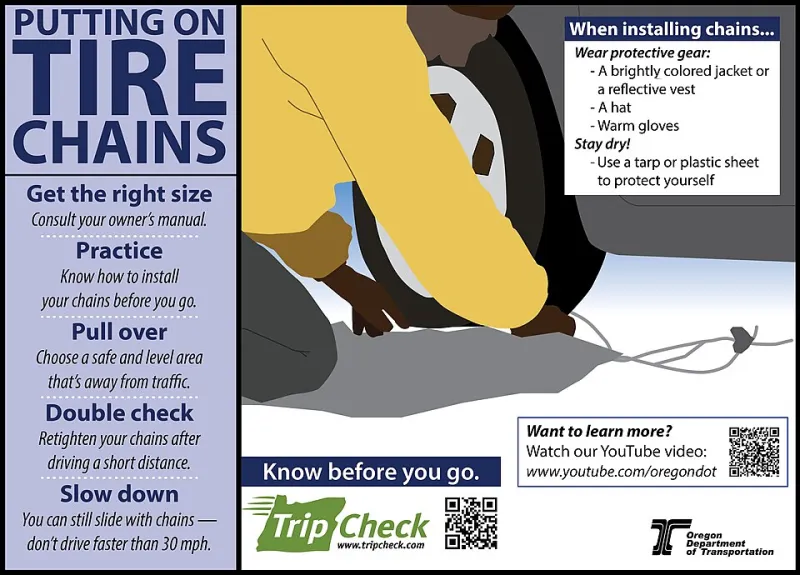
Photo: Oregon Department of Transportation, CC BY 2.0, via Wikimedia Commons
Driving to the Alps is one of the great UK snow-sports rituals. You load the car, argue about roof-box space, and set off with a playlist and a vague plan. Then you hit a snowy access road, a police checkpoint or a sign that says chaînes obligatoires, and the vibe changes fast.
This is not meant to scare you. It is meant to stop you becoming the person who blocks a mountain road because the chains are still in the boot, the wrong size, or still in the wrapper. Here is the SnowHead checklist for UK drivers heading to France, Switzerland, Austria and Italy in 2026/27.
First, the bit that catches people out: your UK insurer
Before you worry about chains, check your insurance. Most UK policies give limited cover in Europe, and the level of cover can be lower than at home. Ring your insurer or read the policy documents and confirm: how many days of foreign cover you get, whether you need to notify them of your trip, whether recovery and repatriation are included, and whether you are covered for driving in all the countries on your route.
Ask about a Green Card if your insurer says you need one. Since Brexit, the rules are not the same as they were, and some insurers issue them automatically while others do not. Check your breakdown cover too — a European policy that will recover a broken car from a French motorway is worth the money. Keep digital and paper copies of everything.
France: the Loi Montagne is not a suggestion
In many French mountain areas, winter tyres or chains are mandatory from 1 November to 31 March. The signs usually say something like équipements obligatoires, and the rules apply to vehicles using signed mountain roads. Winter tyres need the 3PMSF marking — the three-peak mountain snowflake — or you need chains. M+S tyres alone are not always enough.
Carry chains that fit your tyres, even if you have winter tyres. If the police or road signs require chains, you fit them. Do not argue with the sign. Also remember the Crit'Air sticker if your route takes you through a low-emission zone, and keep a hi-vis vest and warning triangle in the car.
Switzerland: conditions rule, even without a blanket law
Switzerland does not have a blanket winter-tyre law, but that is not a free pass. If conditions demand winter tyres, you need them — and your insurer may take a dim view if you crash on summer tyres in the snow. Snow chains are required on certain signed mountain roads, and you should carry them if you are heading to high resorts.
You will need a Swiss motorway vignette if you use the motorway network, and you should check your route for seasonal passes. Some passes close in winter; some are closed at night. Do not let the satnav send you over a high pass in a blizzard because it looks quicker.
Austria: winter tyres and chains when signs say so
Austria requires winter tyres in wintry conditions between 1 November and 15 April. The tyres need to be M+S or 3PMSF, and the rules apply to cars and light commercial vehicles. If you are stopped and the conditions are wintry, summer tyres can lead to a fine and insurance problems.
Chains are required when a sign shows a chain symbol. Fit them to the drive wheels and follow the posted speed limit — usually 50 km/h or lower. Austrian motorways need a vignette, and some tunnels have extra tolls. Keep your lights on and your fuel tank topped up; mountain routes can be slow.
Italy: winter kit or chains, depending on the road
Italy has regional rules, and in many mountain areas winter tyres or chains are required from 15 November to 15 April. Where signs require chains, snow socks are not a universal substitute. Check the local rules for the region you are visiting, especially if you are heading to the Aosta Valley, Trentino or the Dolomites.
Italian motorways have tolls, and some mountain roads are narrow and steep. If you are not confident driving in snow, park lower down and take a shuttle or bus. There is no shame in that. There is also no shame in reading the signs twice.
Chains or socks? Choose for the road, not the brochure
Snow chains are the proper tool for deep snow and steep access roads. Snow socks are easier to fit and can be useful for short, low-speed sections, but they are not a magic fix. Some authorities do not accept socks where chains are mandatory. Check the rules for each country and each road.
Buy chains that match your tyre size — not your wheel size, your tyre size. Practise fitting them at home, in daylight, with gloves on. The first time you fit them should not be on a dark mountain road with a queue behind you. Check the tension after a few hundred metres and re-tighten if needed.
How to fit chains without losing your temper
Pull over somewhere safe, well away from the traffic lane. Put on gloves and a waterproof jacket. Fit the chain to the drive wheels, following the manufacturer's instructions. Move the car forward slowly to settle the chain, then check the tension. Keep your speed low and remove the chains as soon as the road is clear. Do not drive on bare tarmac for miles with chains on; you will damage the chains, the road and your mood.
The pre-trip checklist
- Insurance: European cover, trip notification, breakdown and repatriation
- Tyres: winter or 3PMSF tyres with legal tread
- Chains: correct size, practised, with gloves and a torch
- Documents: licence, insurance, V5C, Green Card if required, booking confirmations
- Car kit: hi-vis vests, warning triangle, first-aid kit, blanket, water, snacks
- Lights: headlamp beam deflectors and spare bulbs
- Vignettes: Swiss and Austrian motorway stickers, French Crit'Air if needed
- Weather: check road closures, pass conditions and avalanche forecasts
- Accommodation: confirm parking and whether the access road is cleared
At the pass: final checks
Before you commit to a mountain road, check the local road status. If the sign says chains are required, fit them before the checkpoint. If the road is closed, do not try to find a shortcut. If you are unsure, park in the valley and take the bus. The mountain will still be there tomorrow.
Driving to the Alps is brilliant when you are prepared and miserable when you are not. Do the boring checks at home, practise the chain fitting, and give yourself extra time. Then you can enjoy the bit you came for: the snow, the views and the first lift on Saturday morning.